Identification & Diagnosis
How to identify which Lithops species you have
A practical framework — window, body color, marking style, origin — that gets you from 'mystery succulent' to a confident shortlist.
Start with the window, not the color
The single most useful feature for identifying a Lithops is the window — the translucent patch on top of each leaf pair that lets sunlight reach the photosynthetic tissue inside. Color shifts with light, water, and season. Window structure is conservative. It changes very little across the life of the plant, which makes it the most reliable starting point.
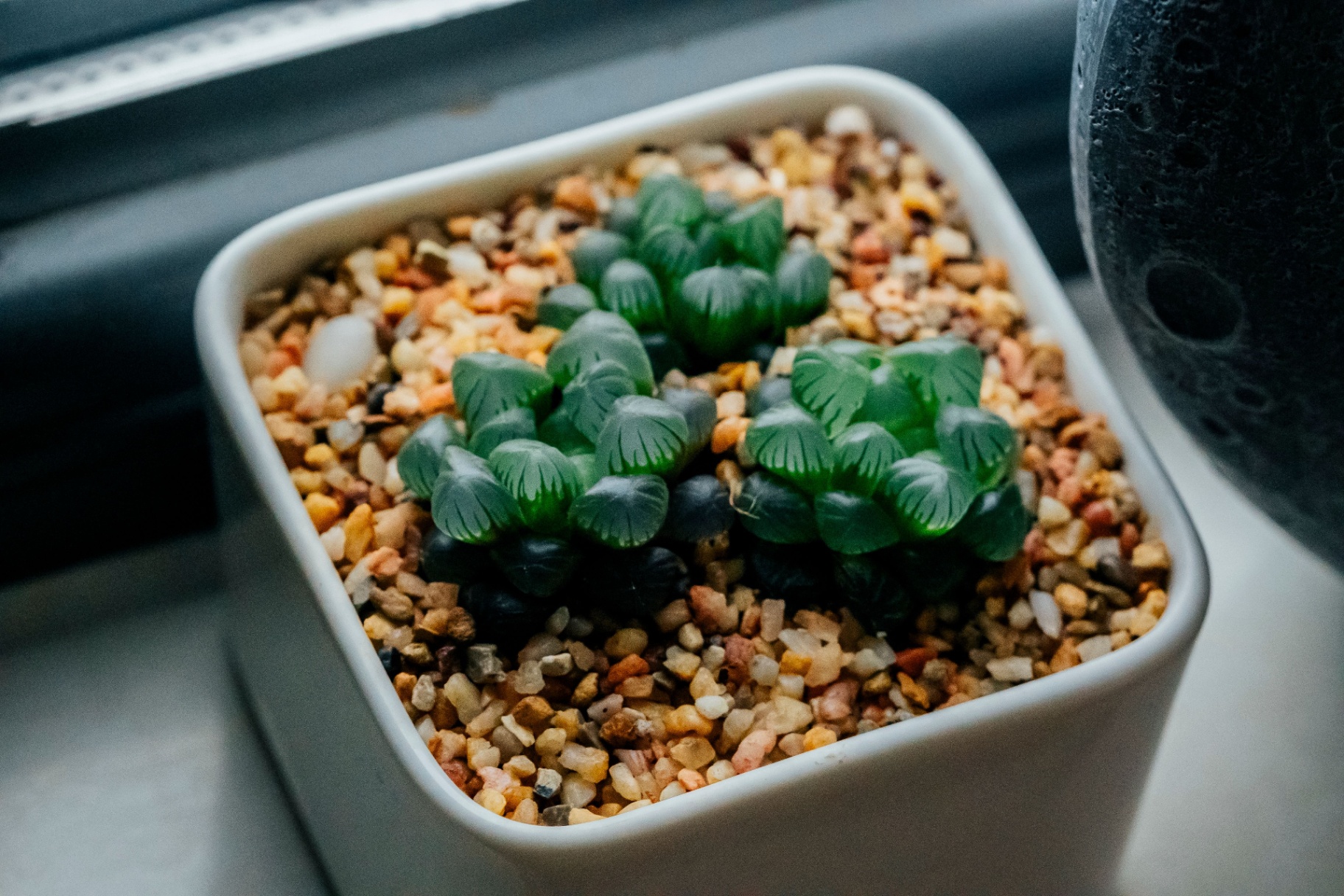
Look down on the plant from directly above, in soft daylight rather than direct sun. The window will fall into one of a handful of patterns: a single open clear patch, an island pattern (translucent dots inside an opaque field), a dendritic or vein-like network of channels, or a dusted/rubricated surface where the top is largely opaque and the window is reduced to fissures along the cleft. Each of those patterns rules out large blocks of the genus immediately.
Solid translucent windows with little patterning point you toward Lithops optica, L. helmutii, L. herrei, L. divergens, and a handful of others where the top is dominated by a clean window rather than a patterned field. Island patterns — discrete translucent dots floating in a darker top — are characteristic of L. julii, L. karasmontana (in some forms), L. salicola, and the L. lesliei complex. Heavy dendritic veining is the hallmark of L. gracilidelineata, while a rubricated, almost stone-like top with the window reduced to a narrow fissure is what you see in L. hookeri, L. pseudotruncatella, and several forms of L. aucampiae.
Body color is a clue, not an answer
Body color is the next most obvious feature, but it shifts with light intensity, hydration, age within the molt cycle, and substrate mineral content. A plant grown under low light reads green-grey; the same clone in bright sun pulls toward terracotta, copper, or smoky violet. Treat color as a tie-breaker between candidates, not as the primary diagnosis.
That said, certain palettes are diagnostic. Deep coppery red-brown with a faint sheen is typical of L. aucampiae. Pure brick-red with no patterning belongs to L. optica 'Rubra'. A flat olive-grey to slate body with a busy island window is L. lesliei. Pale chalky pink, almost peach, is L. salicola or L. julii subsp. fulleri. A cool blue-grey body with bold rust-red rubrication is L. karasmontana, especially the 'Top Red' selection.
Read the markings — rubrications, dusky dots, dendritic channels
Inside the window and around the rim you will usually find one of three marking styles. Rubrications are short rust-red lines, dashes, or hooks pressed into the surface. Dusky dots are dark, slightly sunken specks scattered across the window. Dendritic channels are branching translucent veins that look like a riverbed photographed from above.
Rubrications dominate the L. karasmontana, L. hookeri, and L. terricolor groups. Dusky dots are characteristic of L. julii (the dots can be so heavy the window reads as a busy network) and L. salicola. Dendritic channels are the unmistakable signature of L. gracilidelineata, and to a lesser extent some forms of L. dorotheae and L. otzeniana.
Size and proportions narrow the shortlist
Mature Lithops body diameter varies less than people expect — most species sit between 20 and 40 mm across when fully hydrated. But within that range, proportions matter. L. optica and L. helmutii are tall and narrow with a deep cleft. L. lesliei and L. aucampiae are broad and flat. L. dorotheae and L. dinteri are small, often under 25 mm, with a chunky proportion. L. ruschiorum is among the most elongated, often noticeably taller than wide.
Measure the body across its widest axis, and note whether the cleft is shallow, medium, or deep. A shallow cleft (just a seam) points to L. ruschiorum or L. werneri. A pronounced cleft that nearly splits the body into two separate leaves points to L. divergens and L. comptonii.
Use origin and flower color to confirm
If you know where the plant came from — the nursery's labeling, the seed source, or the collection locality — that radically narrows the candidates. Lithops are habitat specialists; many species are restricted to a single small region of the western Karoo or southern Namibia. A plant labeled with locality data should match one of the species known from that locality.
Flower color is the final tie-breaker. White-flowered Lithops include L. optica, L. helmutii, L. salicola, L. marmorata, L. julii, L. ruschiorum, L. herrei, L. karasmontana, L. hallii, L. divergens, and L. villetii. Yellow-flowered species cover most of the rest, including L. aucampiae, L. lesliei, L. hookeri, L. terricolor, L. fulviceps, L. dorotheae, L. bromfieldii, L. gracilidelineata, and L. pseudotruncatella. A few yellow-flowered species produce a pale lemon flower with a white centre that can fool a quick glance.
A repeatable workflow
Photograph the plant from directly above in even daylight. Note the window pattern, the body color, the marking style, the body diameter, the cleft depth, and the flower color if available. Browse the species directory, eliminate species whose window pattern is clearly different, then compare against the remaining four or five candidates. You will usually land on one, sometimes two, that match every feature.
If you are still stuck between two candidates, weight the window pattern and marking style most heavily — those are the most stable features. Body color and size shift with conditions, and a stressed plant under strong light can read as a different species at first glance.
Frequently asked questions
- Can I identify a Lithops from a single photo?
- Often, yes — if the photo is taken from directly above in even daylight and shows the window pattern clearly. Side photos rarely give you enough information.
- Why does my plant look different in winter than in summer?
- Lithops shift color and shape across the year. Under bright summer light they pull toward warm tones (red, copper, terracotta); in winter under softer light they read greener and greyer. The window pattern stays consistent.
- Is flower color a reliable identifier?
- It narrows the field roughly in half — Lithops are either yellow-flowered or white-flowered, with a few yellow flowers that have a white centre. It's a useful confirmation, not a sole diagnostic.
- What if my plant has no label at all?
- Start with the window pattern, then color and markings, then size. Most unlabeled nursery Lithops are common species — L. aucampiae, L. lesliei, L. hookeri, L. karasmontana, L. salicola, or L. pseudotruncatella.
Keep reading
Written by the Editorial Team. Spotted an error or want to add a regional note? Send corrections or apply to contribute.