Identification & Diagnosis
Lithops vs Pleiospilos vs Conophytum: how to tell them apart
Three genera in the same family that get confused at every garden centre. The features that separate them are unambiguous once you know where to look.
Why the confusion
Lithops, Pleiospilos, and Conophytum are all mesembs — members of the Aizoaceae family, evolved in the dry regions of southern Africa. They all reduce themselves to a small fleshy body, all flower in autumn, and all sit in small pots at nurseries with vague labels. To a casual buyer they look like variations on the same plant.
They are not. They have different growth cycles, different watering needs, and different molting patterns. Mistaking one for another and treating it on the wrong schedule is a guaranteed way to lose the plant.
Lithops: the flat-topped stone
A Lithops body is a pair of fused leaves with a flat or gently domed top, a clear cleft running across the top, and a translucent window covering most of the top surface. The body is short — typically taller than wide only in a few species — and the side walls are nearly vertical. Mature heads are 20–40 mm across in most species.
Lithops molt by replacing the entire body once a year. The old leaves shrivel as a new pair grows inside. Watering calendar: spring and autumn, dry rest in summer and winter.
Pleiospilos: the split rock with multiple leaf pairs
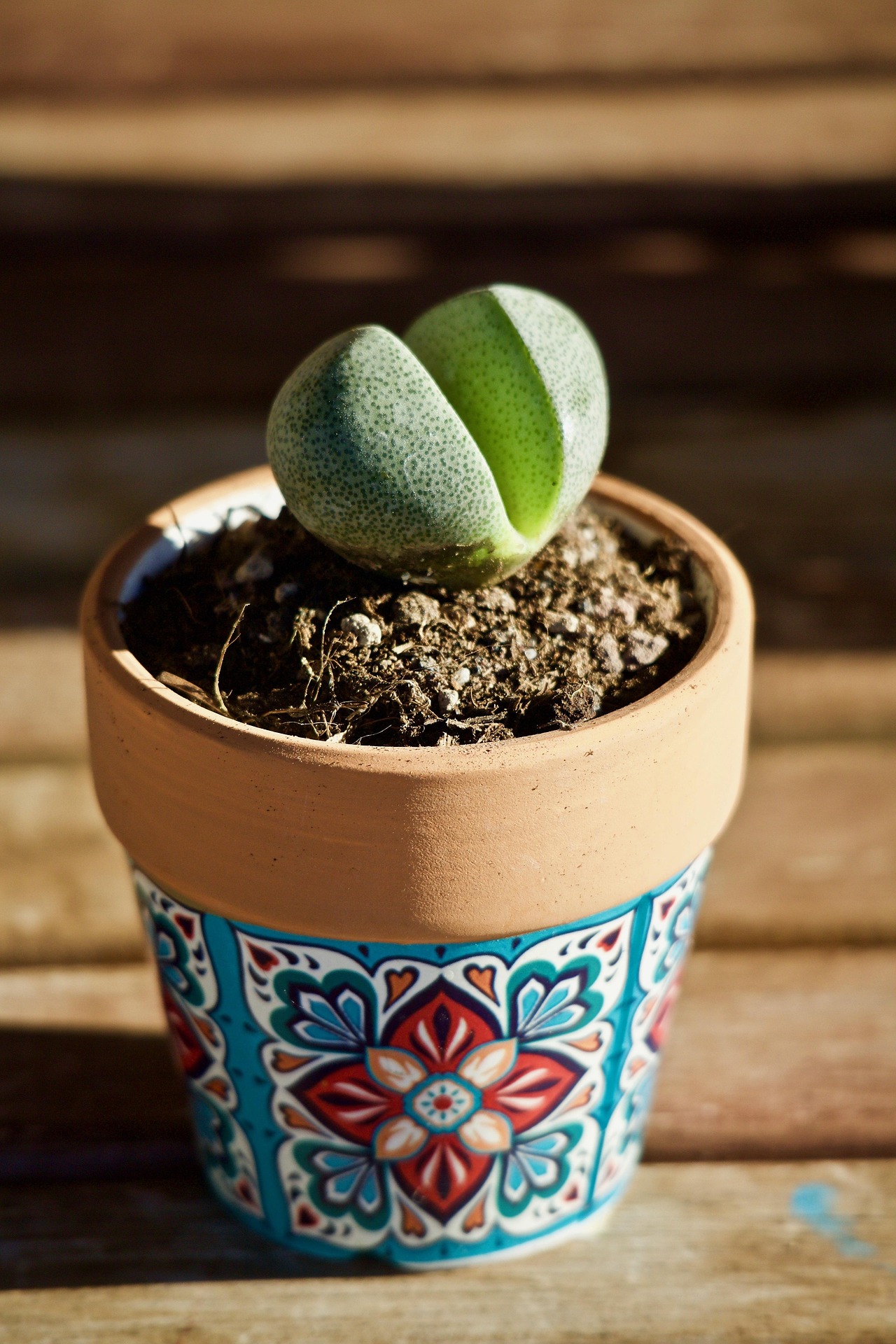
Pleiospilos (the genus most often confused with Lithops at nurseries, especially P. nelii) looks like a chunkier, more rounded Lithops at first glance. Look closer and the differences are clear: a Pleiospilos has a deep central cleft that nearly separates two thick leaves, the leaves are usually domed rather than flat-topped, and there is no translucent window — the top is the same opacity as the sides. The body is generally larger than a Lithops, 40–70 mm or more.
Most importantly, a mature Pleiospilos retains two or more pairs of leaves at once. New leaves emerge from the cleft while the old pair is still firm and green. You can see four to six leaves on an established plant, where a Lithops shows only two.
Pleiospilos is also more forgiving of moisture than Lithops, with a growing season that overlaps but extends further into summer and a less strict molting cycle. Treat it on the Lithops calendar and you will under-water it.
Conophytum: the tiny bodies that hide under skin
Conophytum bodies are usually smaller than Lithops (often under 20 mm) and come in a wider variety of shapes — globular, conical, fissured, bilobed. The translucent window, when present, is much smaller than in Lithops and often confined to dots or thin lines on the apex.
The diagnostic feature is the sheath. Through the dry resting period, a Conophytum forms a papery sheath over the whole body — essentially the dried remains of the previous leaf pair — and stays dormant inside that protective shell until water and cooler temperatures trigger renewal. A Lithops doesn't do this; its old leaves shrivel during molt but don't form a persistent sheath.
Conophytum's watering year is inverted relative to Lithops in some species: many cultivated Conophytum grow in autumn and winter and rest through hot summer, the opposite of much of the Lithops cultivated cycle. Mistaking the two leads to summer rot or winter desiccation.
The quick checklist
Window present and large, body flat-topped, only two leaves visible at a time, body 20–40 mm: Lithops. Window absent, deep cleft, more than two leaves visible, body 40–70 mm+: Pleiospilos. Small body (under 20 mm), dried papery sheath in dormancy, window tiny or absent: Conophytum.
If you bought an unlabeled plant and you're not sure: count the leaves on the head. Two only = Lithops or a young Conophytum (check sheath). More than two = Pleiospilos.
Frequently asked questions
- Can I treat all three the same way?
- No. Each has a different growing season and watering rhythm. Pleiospilos tolerates more water; Conophytum often has an inverted growth cycle versus Lithops.
- Which is easiest for beginners?
- Pleiospilos nelii is the most forgiving of the three and a good starting point. Lithops requires the most discipline around the watering calendar.
- Do they hybridize?
- No — they are separate genera. Some Lithops species hybridize among themselves, but Lithops × Pleiospilos or Lithops × Conophytum crosses do not occur.
- Why are they grouped together at nurseries?
- They all belong to the same family and are sold as 'mesembs' or 'living stones'. The label is a marketing convenience, not a horticultural guide.
Keep reading
Written by the Editorial Team. Spotted an error or want to add a regional note? Send corrections or apply to contribute.