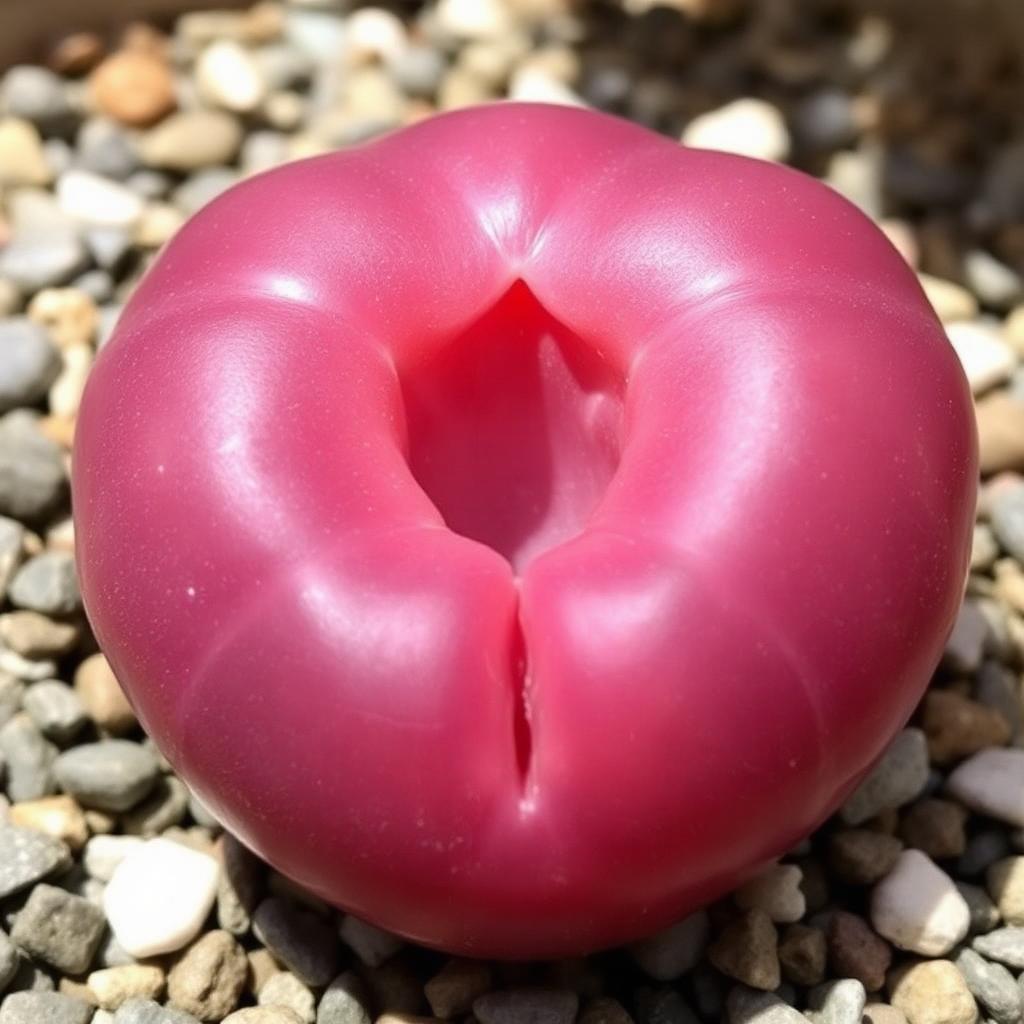
AI-generated reference illustration (pending verified photo) · Photo: AI-generated reference
Species profile
Lithops optica'Rubra'
Red optica · Ruby living stone
- Origin
- Cultivar selection from a population originally near Lüderitz, Namibia (wild L. optica is green)
- Flower
- White
How to identify it
Lithops optica 'Rubra' is the most famous of all Lithops cultivars and, simultaneously, the most misunderstood. The wild species — L. optica from the fog-belt coast of southern Namibia — is uniformly grey-green with translucent, watery windows. 'Rubra' is a chlorophyll-poor mutant selected from a single Namibian population in the 1930s by the South African botanist H.W. de Boer, and it has been propagated by careful selfing and division ever since. Because the plant lacks normal levels of chlorophyll, the underlying anthocyanin pigments dominate, producing the deep wine-red to almost purple color the cultivar is famous for.
Shape is the most reliable identifier. L. optica has unmistakable ear-shaped or kidney-shaped lobes separated by a long, deeply cut central cleft that runs almost the full length of the body. 'Rubra' inherits this shape exactly; what differs is color. The entire top surface is a single translucent red, with no dendritic markings, no island patterns, no dots — just a smooth, slightly waxy red lens. Bodies are smaller than the green parent species, typically 18–25 mm across, and the plant clumps slowly.
If a plant labeled 'Rubra' is partly green, blotched, or bleaches to dull grey under strong light, it is almost certainly mislabeled. Both unintentional hybrids (a 'Rubra' pollinated by a normal green L. optica) and ordinary green L. optica sold under the wrong label circulate widely in the trade. A correctly identified 'Rubra' stays red year-round, intensifying in cooler weather and fading slightly during heat.
Care at a glance
| Light | Bright, filtered light. Unlike most Lithops, 'Rubra' loses its red pigment in extreme direct sun and bleaches toward pink-grey. Aim for very bright indirect light or only a few hours of gentle morning sun. |
|---|---|
| Watering | Less and lighter than typical Lithops. Two or three light waterings in autumn and spring is usually enough; the lack of chlorophyll means lower water demand. |
| Soil | Sharp-draining mineral mix; many growers add extra pumice or perlite compared to standard Lithops mix to compensate for the cultivar's sensitivity to root moisture. |
| Dormancy | Mid to late summer in cultivation; rest is often more pronounced than in green L. optica. |
| Temperature | Comfortable at 10–28 °C; avoid sustained heat above 32 °C. |
| Repotting | Every 3–5 years. Disturb the root system as little as possible — 'Rubra' is slow to re-establish. |
Growth & flowering
'Rubra' follows the same annual cycle as the parent species, but everything happens more slowly. The molt typically begins in late winter and stretches well into spring. The new pair often looks alarmingly pale and shrunken; resist the urge to water. As with all Lithops, the new body lives off the old until the old pair is a dry papery husk.
Flowers are white, sometimes with the faintest pink tint, and they emerge in autumn (October–November in the northern hemisphere). They are smaller than the flowers of most yellow-flowered Lithops — usually 20–28 mm across — and open in the afternoon. Because the cultivar is chlorophyll-poor and slower to build reserves, it does not bloom every year, and very young plants may not flower for the first five or six seasons.
Propagation is exclusively by seed (which requires hand-pollination between two genetically compatible 'Rubra' plants, and even then yields a percentage of green seedlings that must be culled) or by division of older clumps. There is no clonal tissue-culture supply of true 'Rubra' on the hobbyist market, which is why prices are routinely 3–5× higher than for ordinary L. optica.
Common problems
Bleaching to dull pink or grey
Fix: Too much direct sun. Move to filtered light or shade-cloth a south-facing window. Color should deepen back within 4–6 weeks.
Soft, collapsing body after watering
Fix: 'Rubra' is far more sensitive to overwatering than green Lithops. Reduce watering volume by half, water only when the body is visibly wrinkled, and check that your mineral grit fraction is at least 70%.
Refuses to molt or molts incompletely
Fix: Usually a result of summer watering during dormancy. Keep dry from mid-June to mid-August, then resume light watering only after the new body is visible and the old pair has started to shrink.
Slow or no growth for a full year
Fix: Often normal — 'Rubra' is intrinsically slow. Verify that light is adequate, then leave the plant alone. Repotting a sulking 'Rubra' will usually make things worse, not better.
Contributed by
Reviewed by the Appsbarn editorial team. Are you a grower of Lithops optica? Co-author this profile.
Related species
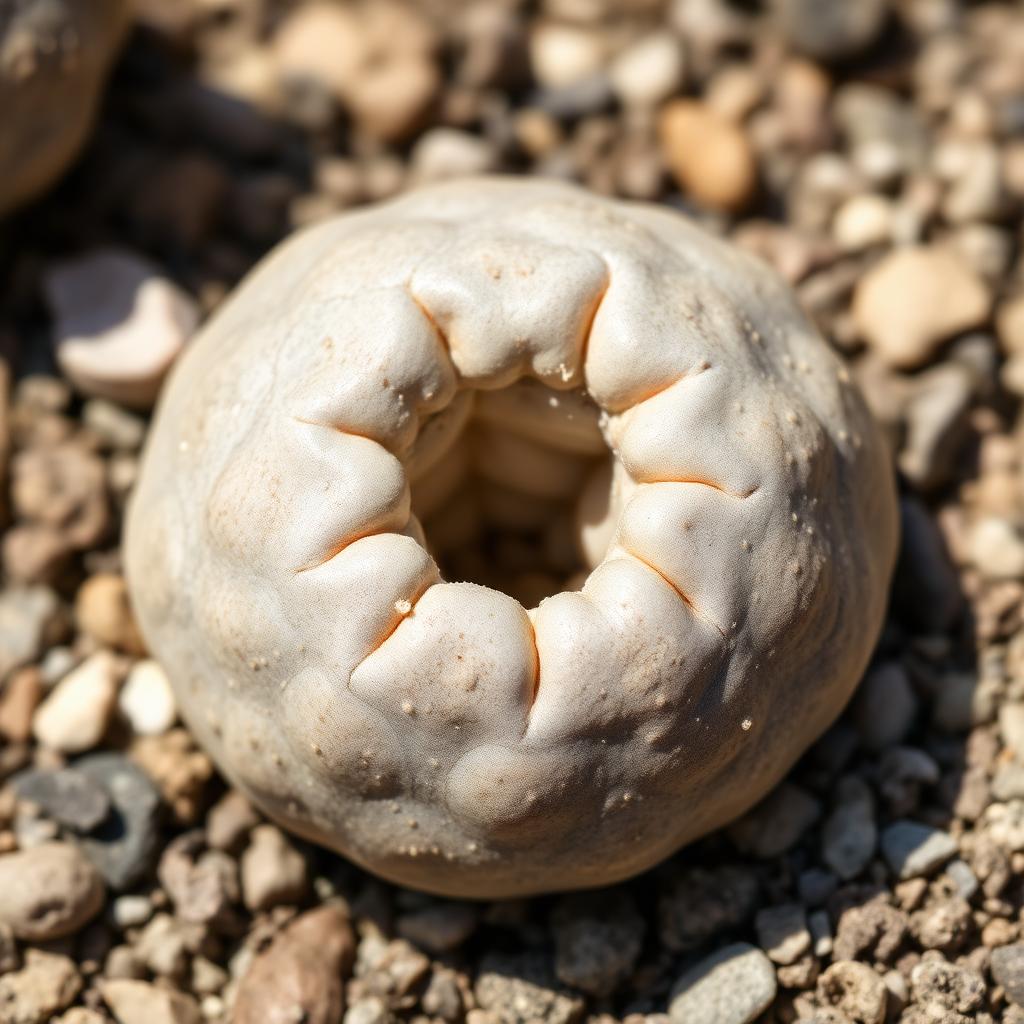
Lithops hermetica
Hermetic living stone
One of the most recently described species — closed-window appearance.
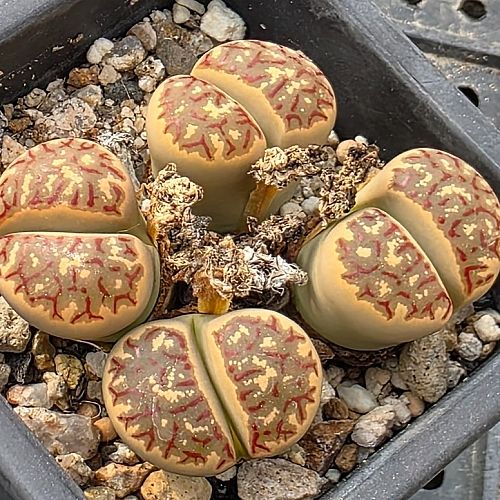
Lithops karasmontana'Top Red'
Top Red karasmontana
A widely propagated red-windowed selection of L. karasmontana.
Lithops optica
Optical living stone
The species behind the famous 'Rubra' cultivar — ear-shaped lobes, translucent windows.
Share your photo of Lithops optica
We feature reader photos in species profiles, with credit. Submissions are reviewed before publishing.
Comments
Comments are moderated per our Community Guidelines. Please keep things on-topic — share your experience growing Lithops optica.
No comments yet. Be the first to share your experience.