Photo: Community contribution — Unknown
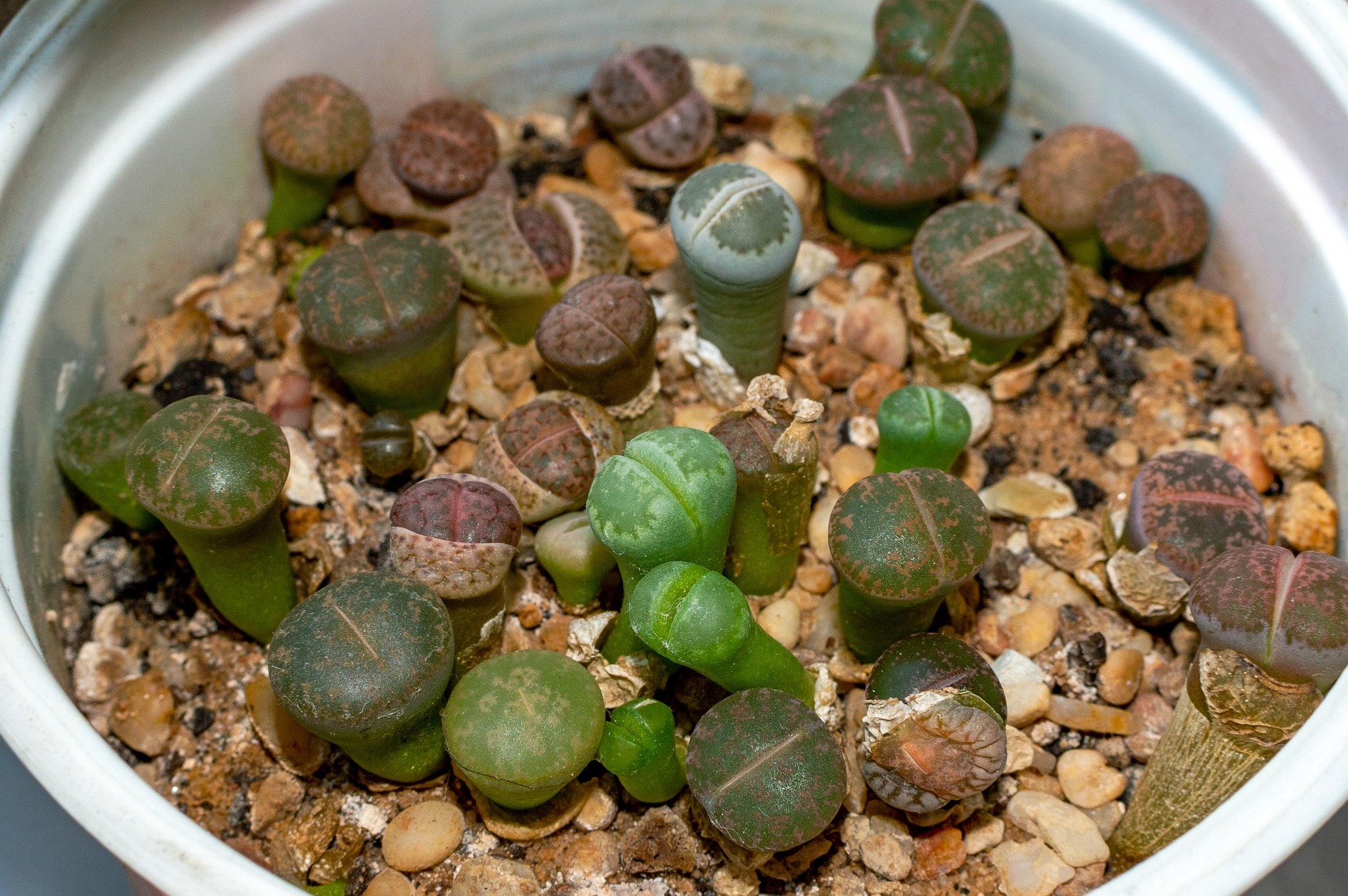
Photo: akuptsova (Pixabay) — Pixabay-Content-License
Species profile
Lithops karasmontana
Karasberg living stone · Mountain Lithops
- Origin
- Karas Mountains, southern Namibia and adjacent Northern Cape, South Africa
- Flower
- White
How to identify it
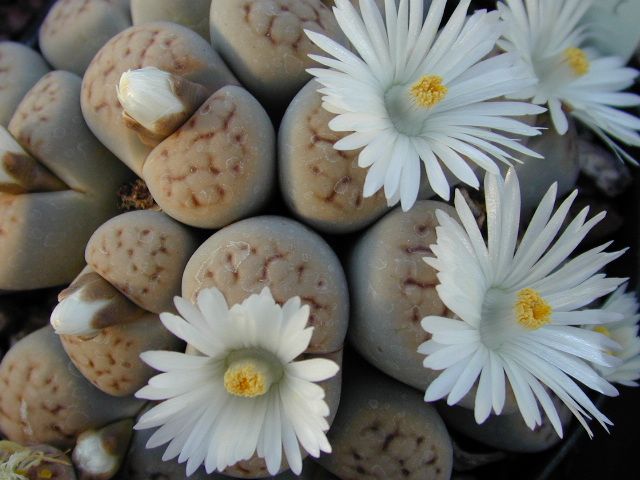
Lithops karasmontana is one of the most recognizable members of the genus and, for many collectors, the species that first hooked them on Lithops. It takes its name from the Karas Mountains of southern Namibia, where it grows on quartzite ridges and in shallow gravel pans, often half-buried among pebbles of almost identical color. The species is widespread and variable: at least four named subspecies and dozens of described forms exist, ranging from almost white-bodied plants with delicate red veining to deeply colored 'Top Red' selections with broad rust-red windows.
Size is the first thing you notice. L. karasmontana is among the larger Lithops, with mature heads commonly reaching 30–40 mm across the top surface and around 25 mm tall. The body is broadly truncate — wide and flat-topped — rather than the egg-shape of L. aucampiae or the ear-shape of L. optica. The central cleft between the two lobes is moderate, neither hidden nor deeply cut.
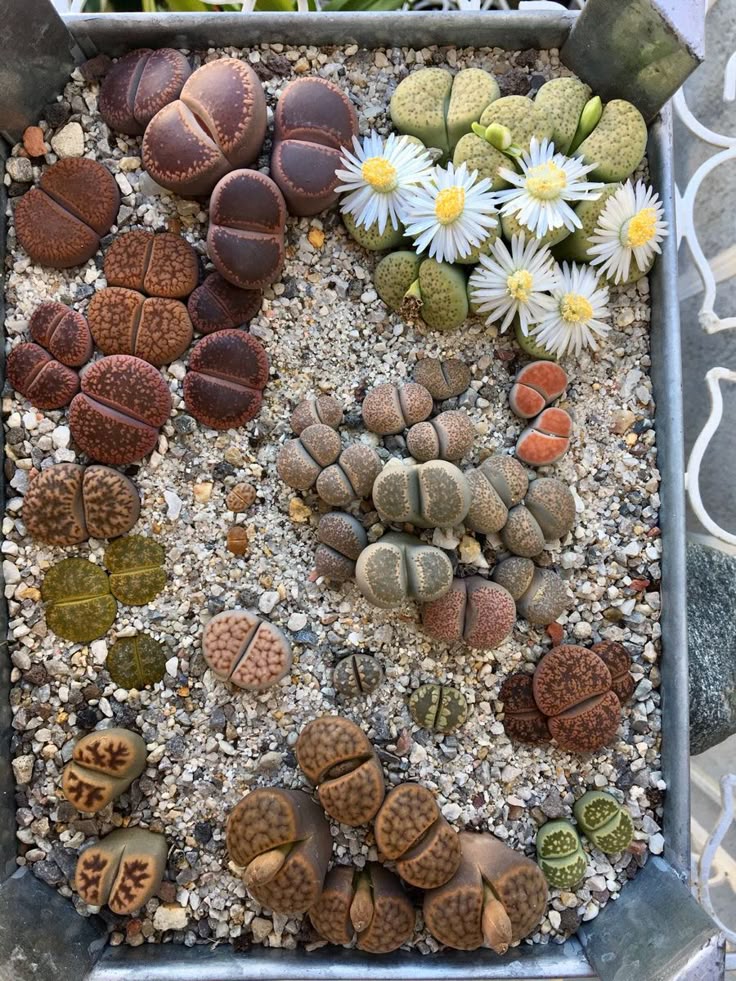
Surface texture is the most diagnostic feature. The top of L. karasmontana is notably rough and rugose, with a chalky, almost lime-washed finish that contrasts sharply with the smooth windows of species like L. optica or L. salicola. Across this textured surface runs a network of rust-red to coppery-brown lines that follow the furrows of the rugose pattern — the characteristic 'brain-coral' or 'wrinkled' top that has earned the species its informal name in collections.
Color in the genus is famously variable, and L. karasmontana shows this in full. Forms range from the near-white bodies of subsp. eberlanzii with thin red lines, through the warm pinkish-cream of typical karasmontana, to the saturated rusty-red of cultivars like 'Top Red' and 'Lateritia.' All forms tend to deepen in color through autumn and winter as light intensity increases relative to temperature.
Care at a glance
| Light | Maximum light short of summer scorch. Direct morning to midday sun is welcomed; in summer afternoons, shade-cloth or filtered light prevents bleaching. |
|---|---|
| Watering | Deep but infrequent waterings during autumn growth and the post-molt period in spring. No water during the summer dormancy, and minimal water in winter. |
| Soil | Mineral-heavy, deep, gritty mix. A 75% inorganic / 25% organic blend is a safe default. |
| Dormancy | Pronounced summer dormancy in cultivation, especially in warm climates. Treat the plant as 'asleep' from roughly mid-June through August. |
| Temperature | Hardy in cultivation between 5 °C and 35 °C; sweet spot is 12–28 °C. |
| Repotting | Every 3–4 years; the species develops a robust root system that benefits from a deep pot (≥10 cm). |
Growth & flowering
The annual cycle of L. karasmontana is textbook Lithops and a good template for understanding the genus. Flowering occurs in mid-autumn — typically October in the northern hemisphere — and the flowers are pure white, large for a Lithops (often 30–40 mm across), and sweetly scented. They open in the early afternoon and close again as light fades, repeating for three to five days per bloom. Self-incompatible like most Lithops, the species requires two genetically distinct plants to produce viable seed.
After flowering the plant rests through early winter, then enters its molt in late winter to early spring. As with all Lithops, the new pair of leaves draws water and nutrients from the old pair as it forms; the old pair shrinks and ultimately reduces to a thin dry husk on either side of the new body. Watering during this period — even a light misting — is the single most common cause of trouble in cultivated L. karasmontana. Wait until the husk is fully dry and starting to flake away before the first spring watering.
Summer is the species' deepest rest. In its Namibian habitat, summer rain is unreliable and surface temperatures can exceed 50 °C; the plant retreats into the soil via its contractile roots and effectively shuts down. In cultivation, mimic this with a strict dry rest from roughly mid-June through August, providing only shade and ventilation. A single light overhead misting on a cool evening every few weeks is the most water a karasmontana wants in midsummer.
Common problems
Heads stacking on top of one another
Fix: Caused by watering during the molt. Stop water as soon as the new pair shows in the cleft; resume only when the old husk is papery and dry.
Pale, washed-out window color in spring
Fix: Often natural — color recovers as light and cool nights return in autumn. If the body is also etiolated (taller than wide), supplement light significantly.
Splitting top surface after late-summer watering
Fix: A plant kept too dry through summer can split when watering resumes too aggressively. Start with smaller waterings to rehydrate gradually.
Soft brown rot at the base in winter
Fix: Overwatering at low temperatures. Keep the soil bone-dry below 10 °C and improve ventilation; warmth, not water, is what gets a cold Lithops through winter.
Fungal spots on the window surface
Fix: Usually from water sitting on the top of the plant. Water from below or pour at the soil surface, and ensure good airflow after watering.
Contributed by
Reviewed by the Appsbarn editorial team. Are you a grower of Lithops karasmontana? Co-author this profile.
Related species
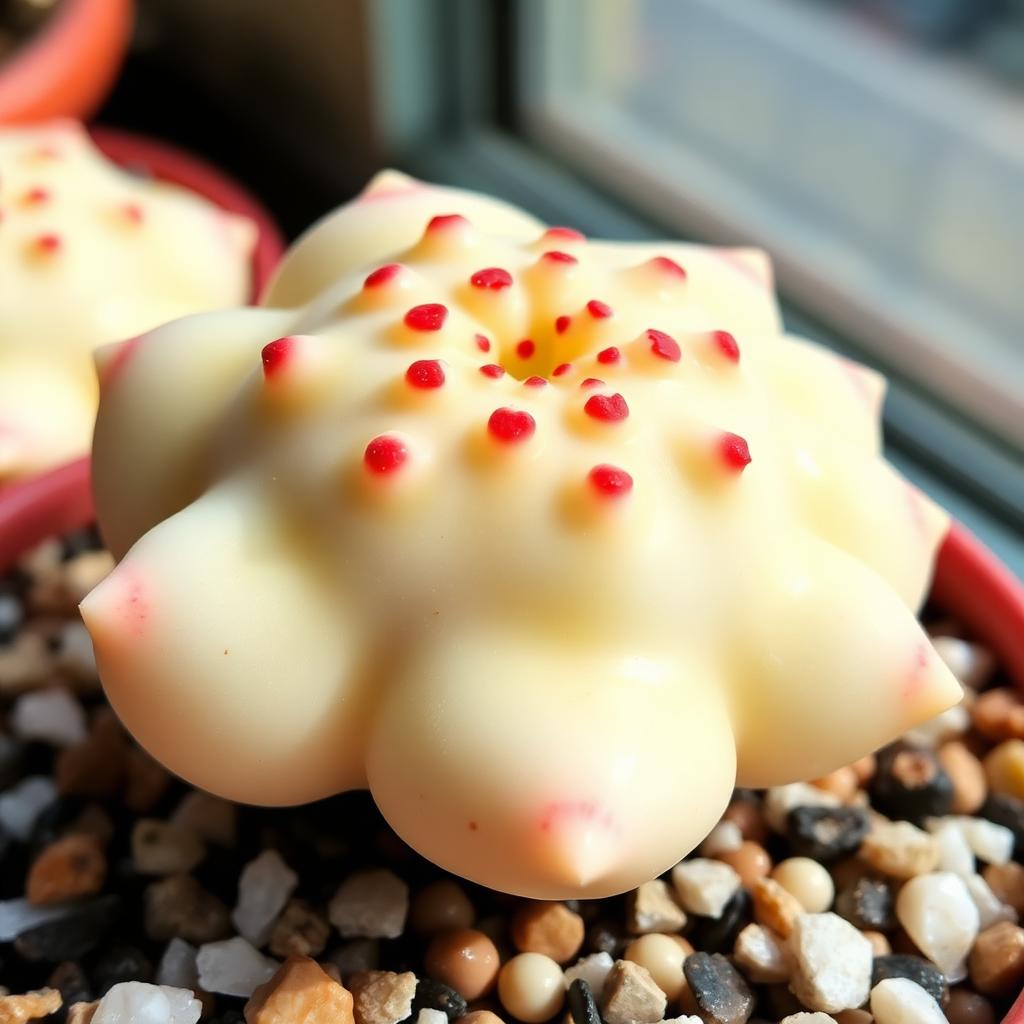
Lithops dorotheae
Dorothy's living stone
Cream and yellow-toned windows with bright red dots — a collector favorite.
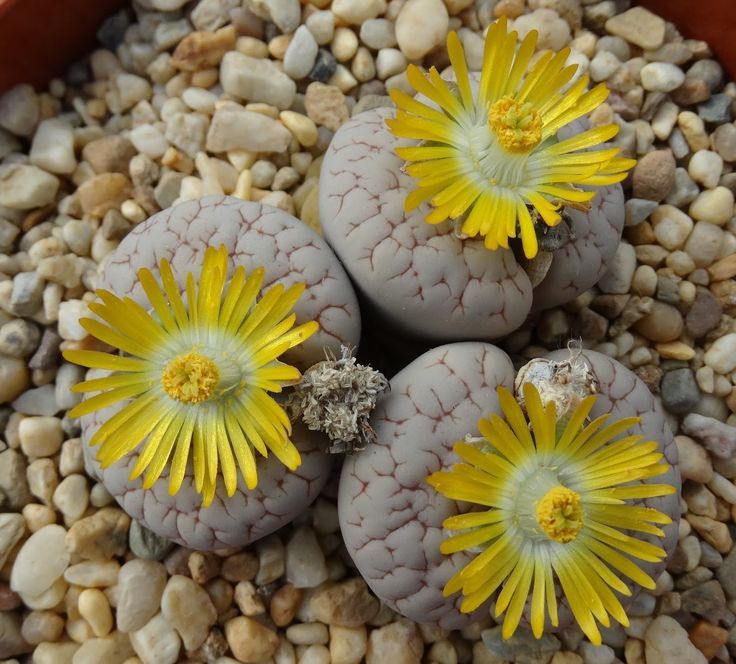
Lithops gracilidelineata
Slender-lined living stone
Pale, almost porcelain body etched with fine, hair-thin dark lines.
Lithops hallii
Hall's living stone
Reliable and variable — heavily patterned windows, often coppery toned.
Share your photo of Lithops karasmontana
We feature reader photos in species profiles, with credit. Submissions are reviewed before publishing.
Comments
Comments are moderated per our Community Guidelines. Please keep things on-topic — share your experience growing Lithops karasmontana.
No comments yet. Be the first to share your experience.