Care Fundamentals
The Lithops molting cycle, explained
Why a Lithops replaces its body every year, what's happening inside the leaves, and what you should and shouldn't do while it's happening.
What molting actually is
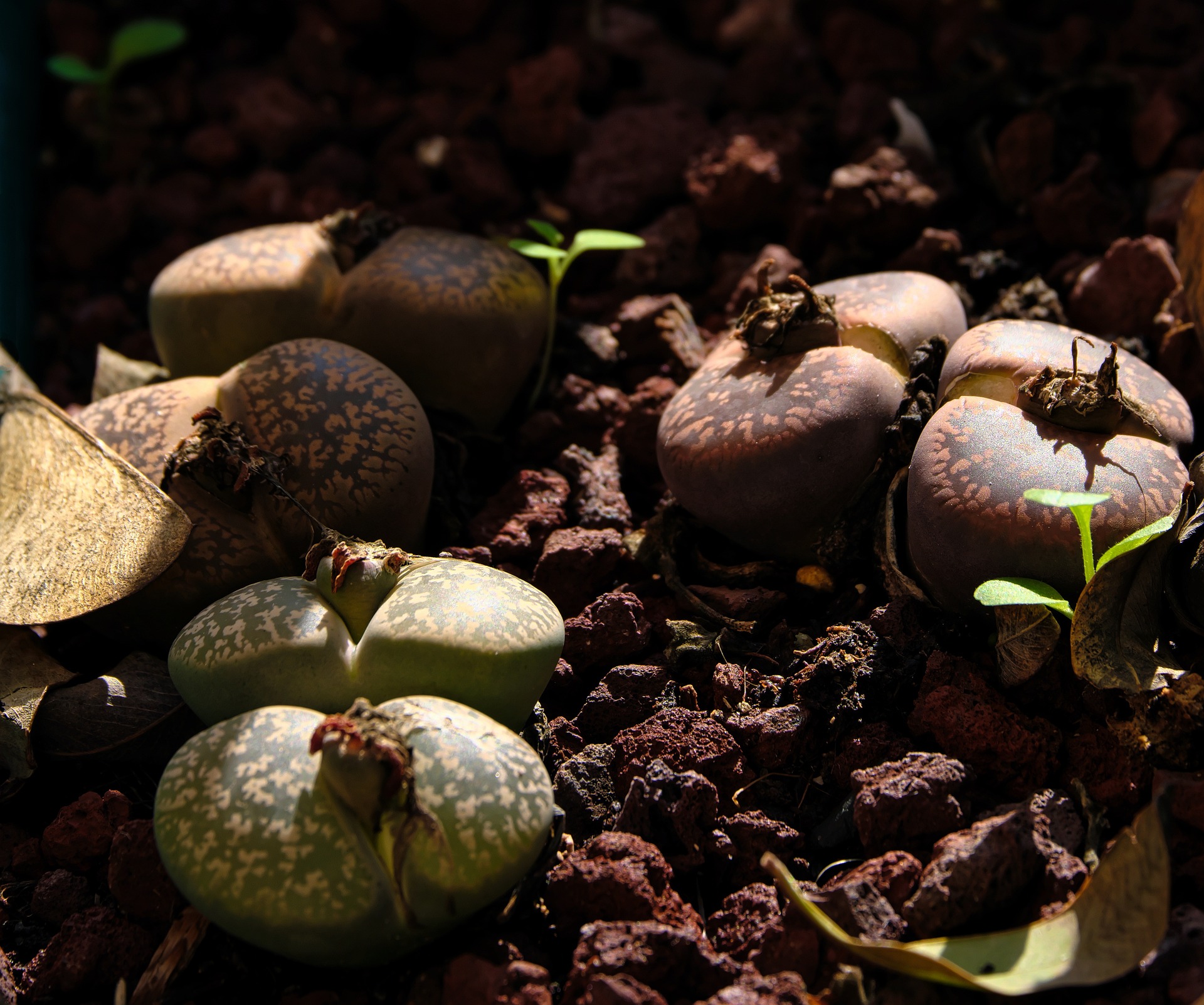
Each Lithops body is a pair of fused succulent leaves. Once a year, the plant grows a new pair of leaves inside the old pair, then sheds the old leaves as the new pair expands. This is the molt. It is not optional, it is not a sign of distress, and it cannot be skipped without long-term consequences for the plant.
The cycle is an evolutionary adaptation to a habitat where water arrives unreliably. The old leaves act as a water and nutrient bank that fuels the construction of new leaves, allowing the plant to renew itself without depending on external water during a vulnerable phase. By the time the molt finishes, the plant has effectively recycled its own body — same root system, same axis, fresh leaves.
When it happens
In cultivation in the northern hemisphere, most Lithops begin to molt in late January or February and finish by April or May. Plants in the southern hemisphere shift by six months. There is variation by species — L. optica and L. salicola often start a few weeks earlier, while L. aucampiae and L. lesliei tend to run later — and variation by individual plant and conditions, especially light intensity through winter.
First-year seedlings do not molt in the traditional sense. They grow continuously for the first 12 to 18 months, gradually settling into the adult cycle by their second or third year.
Stage 1: the cleft widens
The first visible sign is a slight softening of the existing leaves and a thin slit appearing along the central cleft. Inside the slit you may catch a glimpse of the new tissue — usually a slightly different color from the old leaves, often a fresh peach, lemon, or pale green that contrasts with the weathered exterior.
At this stage the plant has fully committed to the cycle. Withhold all water. The old leaves will continue softening as their internal water moves into the new pair.
Stage 2: the new pair expands
Over the next four to eight weeks the new leaves grow inside the old, gradually pushing the old leaves apart. The cleft widens visibly. The old leaves go from soft to wrinkled to papery, and their color fades to a pale tan or grey.
The new pair will usually orient perpendicular to the old pair, so a plant that had its cleft running east-west the previous year will have its new cleft running north-south. This is how Lithops gradually rotate their axis over years.
Stage 3: release
When the new pair is fully expanded, the old leaves are dry husks that peel back naturally. Most plants release the old skin without help. If a husk is fully papery but still wrapped around the new leaves, you can peel it away gently — but only if it is completely dry. Any moisture left in the husk and it should stay on the plant until it finishes drying.
After release, the plant is in its new body. Late spring is the appropriate time for its first watering, and the growing year begins.
What can go wrong
Stuck molts (also called stacked molts) happen when watering during the cycle keeps the old leaves alive past their natural senescence. The old pair refuses to die back, and the new pair is trapped inside, sometimes for an entire year. The fix is no water and patience; in severe cases the plant will essentially skip a year and only the next molt will fully resolve the layered body.
Doubling — two new pairs from one head — is normal on mature plants and excessive only when paired with rich substrate or fertilization (see the irregular-splitting guide). Lopsided pairs reflect uneven light during the previous growing season.
Failure to molt at all is rare in healthy plants. It usually means the plant was kept too warm and too wet through winter, never received the cold/dry trigger, and is in a kind of vegetative hold. Move to cooler, brighter, drier conditions and the cycle should resume the following winter.
What to do while it's happening
Nothing. The single best action during a molt is to leave the plant alone in bright light with no water. Resist the urge to peel, water, repot, fertilize, or move. The plant has everything it needs in the old leaves; your job is to not interrupt.
Frequently asked questions
- Should I peel off the old leaves?
- Only if they are completely dry and papery. Never pull on a husk that still has any moisture or softness — you risk damaging the new leaves.
- My plant has been molting for three months. Is that normal?
- Yes. The whole cycle commonly takes six to ten weeks, sometimes longer in cooler conditions. As long as the new pair is expanding and the old is drying, it's progressing.
- Can I tell the new species from the new leaves?
- Often more clearly than from the old leaves. New leaves show fresh window pattern and marking before sun and age modify the color.
- Why is my new pair smaller than the old?
- Insufficient light or undernourishment in the previous growing season. The plant built smaller new leaves with the reserves it had. The next cycle should be normal with corrected conditions.
Keep reading
Written by the Editorial Team. Spotted an error or want to add a regional note? Send corrections or apply to contribute.