Identification & Diagnosis
The Lithops karasmontana complex by population
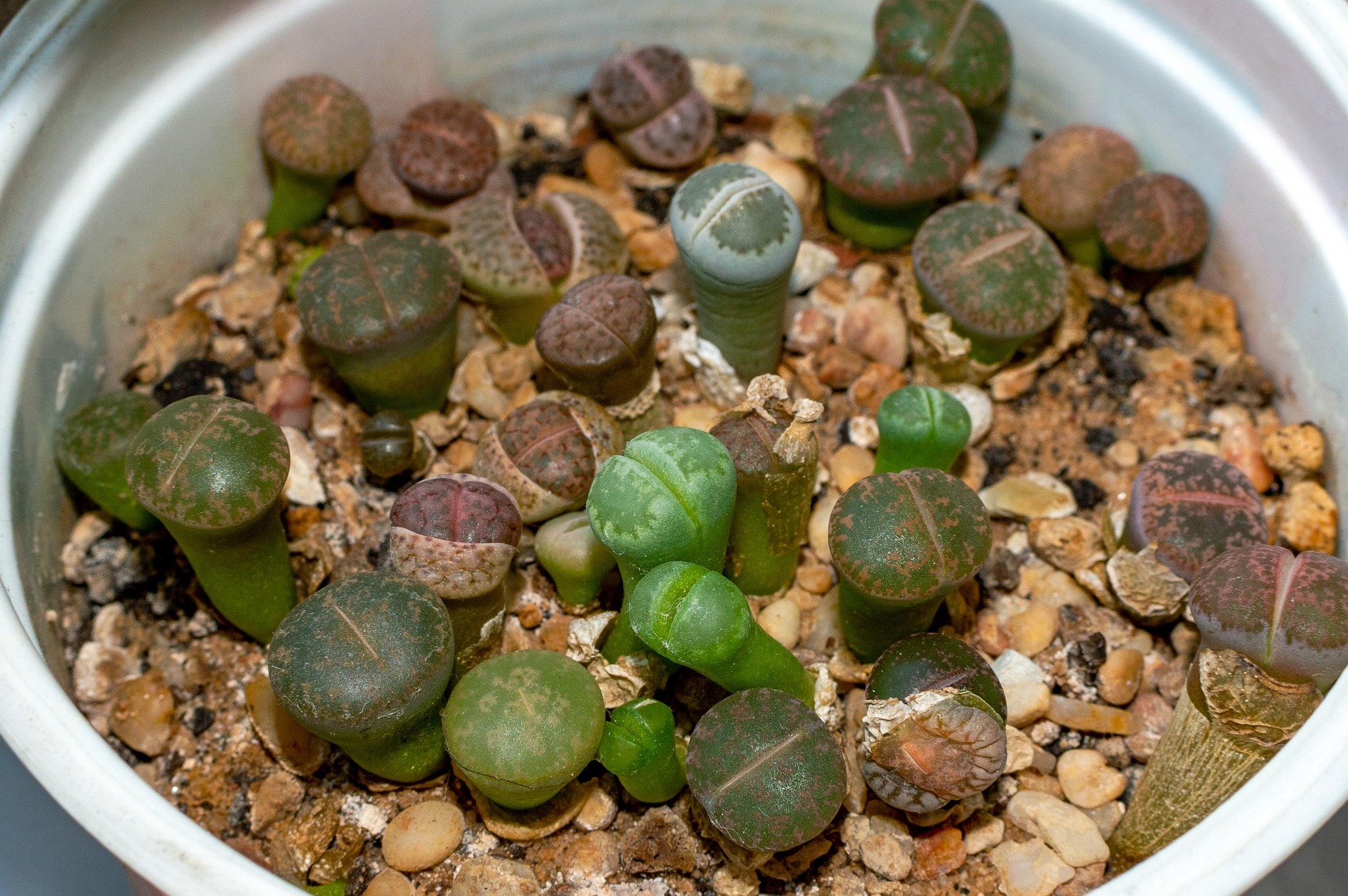
L. karasmontana is one of the most variable species in the genus. A walk through the named forms — bella, lericheana, tischeri, mickbergensis — and what makes each visually distinct.
Why karasmontana is hard
The species spans a huge range across southern Namibia and into the northern Cape, and the populations have responded to local quartz colour, altitude, and rainfall with strikingly different morphologies. A grey-green Karas Mountains plant and an orange-red Bushmanland plant can be the same species.
var. karasmontana and bella
Nominal var. karasmontana has a grey-green to soft grey body with a complex, dense window pattern of fine red-brown markings. var. bella is paler — a chalky greenish-cream — with simpler markings and an almost glaucous bloom on the body.
var. lericheana and tischeri
var. lericheana runs orange to coppery, with a strong red flush along the cleft and a more open, rust-coloured window. var. tischeri shows the deepest red bodies of the complex, particularly the famous 'Top Red' cultivar selected from it.
var. mickbergensis and aiaisensis
var. mickbergensis is a smaller-bodied form from the Mickberg with reduced patterning and a softer overall colour. var. aiaisensis from the Ai-Ais area is intermediate — grey-pink body with moderate dendritic veining and a noticeable cleft line.
Frequently asked questions
- Do these forms cross in cultivation?
- Yes. Seed offered as a specific variety often produces a spectrum of intermediates if the parent plant was open-pollinated in a mixed collection.
- Is 'Top Red' a variety?
- No — it is a cultivar selected from var. tischeri stock. The quoted name is the giveaway.
- Are any of these recently reclassified?
- Yes. The taxonomy has shifted multiple times since Cole's 2005 monograph; current consensus accepts the varieties named above, but expect ongoing revision.
Keep reading
Written by the Editorial Team. Spotted an error or want to add a regional note? Send corrections or apply to contribute.