Care Fundamentals
The best soil mix for Lithops (and why drainage matters)
A mineral mix that drains in seconds, not minutes. Specific components, ratios, and the principle behind the choices.
The principle: dry fast, breathe always
In habitat, Lithops grow in mineral soils dominated by sand, quartz, and weathered rock with almost no organic content. Rain percolates through these substrates in seconds and the surface is dry within hours. Roots are surrounded by air more than water for most of the year.
Replicating that in a pot is the single most important thing you can do for long-term Lithops health. A mix that drains in seconds and dries fully within 48 hours will forgive a generous range of watering mistakes. A water-retentive mix punishes even careful watering. Substrate choice is more consequential than schedule.
A reliable mix
A simple, repeatable mix that works in most conditions: 70% mineral grit (a blend of pumice, lava rock, akadama, or coarse perlite), 20% coarse sand (washed horticultural sand or sharp quartz sand, not building sand), and 10% sieved low-nutrient organic component (coir, sieved peat-free houseplant compost, or sieved coco fiber).
If you garden in a humid climate or a cool indoor environment, push the mineral content higher — 80% mineral, 15% coarse sand, 5% organic. In a hot, dry climate or under strong light, you can go a little softer at 60/25/15, but the bias should always be heavy on grit.
Components, ranked
Pumice is the gold standard: lightweight, porous, holds a small amount of moisture without staying wet, and provides excellent root aeration. If you can source 3–6 mm horticultural pumice, build your mix around it.
Lava rock (scoria) is similar to pumice and often easier to find. Slightly denser, equally good for drainage. Mix sizes are fine.
Akadama is a fired clay favored in bonsai culture. Excellent for Lithops, especially the harder grades that don't break down quickly. Slightly more water-retentive than pumice but the structure stays open.
Perlite works if pumice is unavailable. Use coarse grade. Avoid fine perlite, which can cake.
Coarse sand should be sharp and washed. Builder's sand, play sand, and beach sand all contain fines that clog drainage and often carry salts. Source horticultural-grade washed sand from a garden center or aquarium gravel in 1–3 mm grade.
Organic component should be sieved to remove fines, and used sparingly. Its job is to give the mix a small amount of nutrient buffering and to help roots get established — not to retain water.
What to avoid
Generic 'cactus and succulent' commercial mixes are usually far too organic for Lithops. They are formulated for sub-tropical succulents that tolerate moister substrates. Out of the bag, they hold water for days. If a commercial mix is the only option, cut it 50/50 with pumice or lava rock before use.
Peat-heavy mixes are the worst choice. Peat dries hydrophobic — it goes from saturated to repellent without passing through a healthy damp-but-draining intermediate. Lithops roots cannot manage that transition.
Fine sand caked under a layer of grit looks fine until you water; then it turns to slurry. Sieve all components and discard fines under 1 mm.
Top dressing
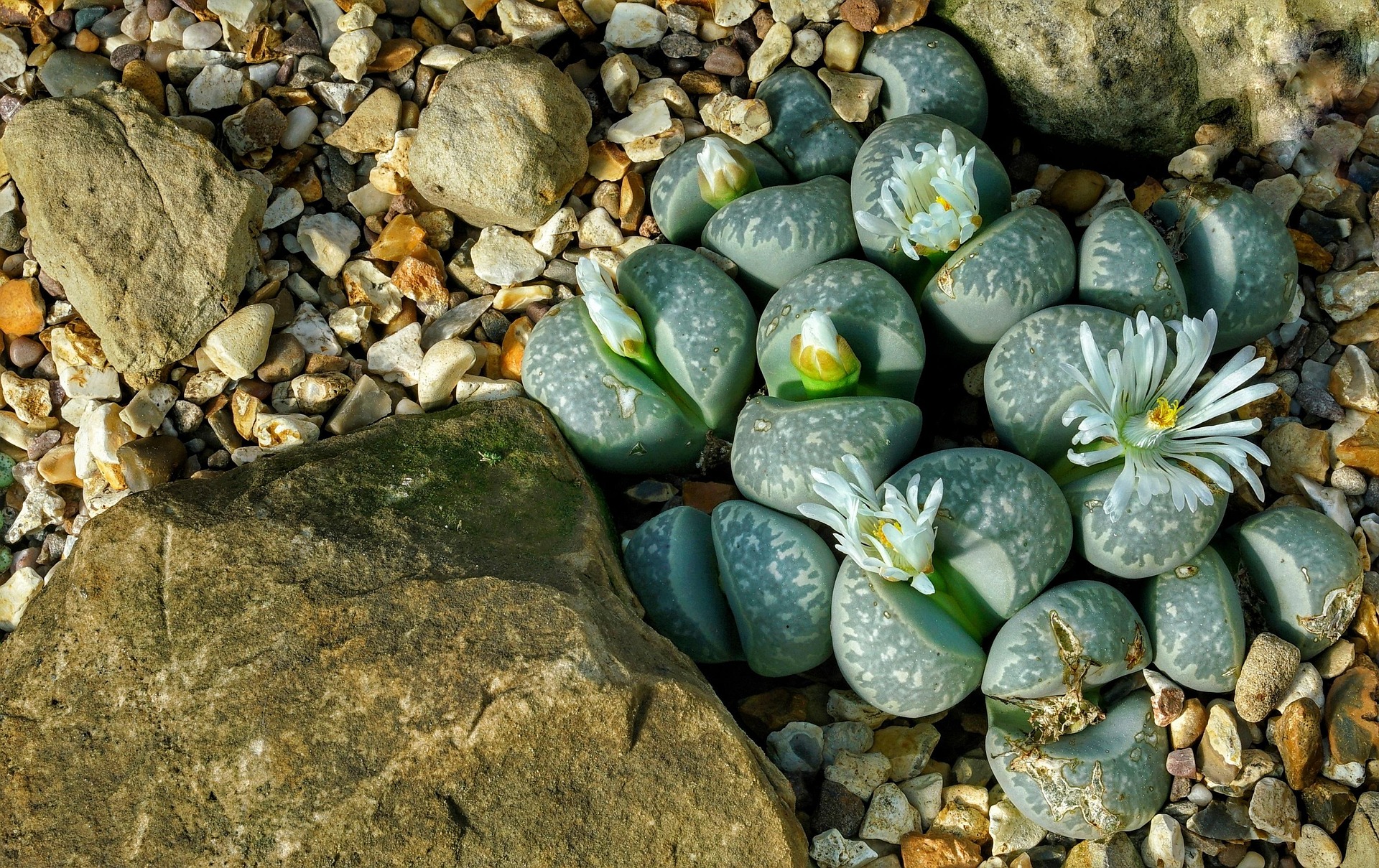
Top the pot with a layer of decorative grit (small quartz pebbles, granite chips, or aquarium gravel) at least one body-thickness deep around the plants. The top dressing keeps the bodies dry, prevents water from splashing onto the plant during watering, and discourages the formation of moss or algae on the substrate surface.
Top dressing also helps you read the substrate's moisture state — lift a pebble and look. If the grit underneath is dry, the plant is dry.
Pot choice supports the mix
Use pots with generous drainage holes. Unglazed terracotta wicks moisture and dries faster — useful in humid or cool environments. Glazed ceramic and plastic hold moisture longer and can work in dry, hot climates. Pot depth should comfortably accommodate the root system; Lithops have a surprisingly long taproot for their size, and a pot of at least 8–10 cm depth is sensible for an adult plant.
Repot every two to three years to refresh the mix. Components break down, fines accumulate, and drainage degrades over time even in a well-built substrate.
Frequently asked questions
- Can I use cactus soil straight from the bag?
- Usually not. Most commercial cactus mixes are too organic for Lithops. Cut them with at least 50% pumice or coarse grit.
- Is sand alone enough?
- No. Pure sand compacts and drains poorly once wet. You need a mix of particle sizes for stable structure.
- How often should I repot?
- Every two to three years for an established plant. Sooner if drainage has noticeably slowed or the mix looks decomposed.
- Do I need to add fertilizer?
- No. Lithops in proper mineral substrate need no supplemental feeding. If you do feed, use a quarter-strength low-nitrogen cactus fertilizer once at the start of each growth window, never more.
Keep reading
Written by the Editorial Team. Spotted an error or want to add a regional note? Send corrections or apply to contribute.