Identification & Diagnosis
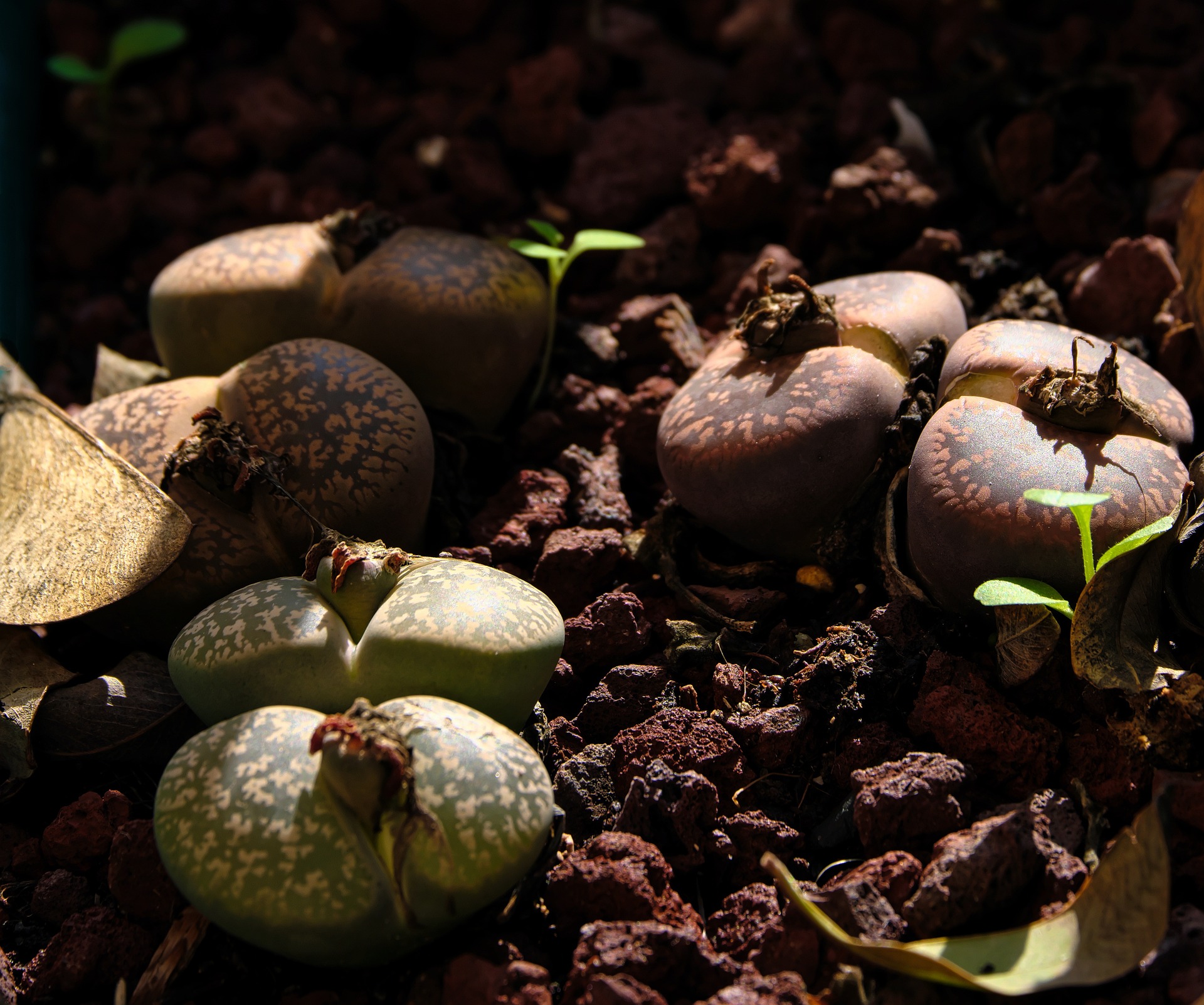
Lithops lesliei vs Lithops hookeri side by side
The two species are routinely confused because both are large, rubricated, and South African. Here is what actually separates them.
Window pattern
L. lesliei has the classic 'island' window — discrete translucent dots inside an opaque rubricated field. The islands are usually irregular in shape and size.
L. hookeri has a more dendritic window — branching channels and fissures rather than discrete islands. The opaque field is also rougher, almost stone-like, and the cleft is often deeper.
Body shape and colour
L. lesliei tends to be flatter on top, with a body that grows wider than tall as it matures. Colours run grey-green, coppery, to deep brown depending on form.
L. hookeri is more cylindrical, slightly taller relative to its width, and runs more uniformly brown to red-brown across its forms.
Habit and habitat
L. lesliei readily forms tight clusters of many heads in cultivation; L. hookeri stays solitary or in small groups much longer. In habitat, lesliei occupies grasslands at higher altitude on the Highveld; hookeri sits on warmer, drier slopes further west.
Frequently asked questions
- What about L. aucampiae?
- Closer to hookeri visually, with coppery bodies and dendritic windows. Use the cleft depth — hookeri's is deeper — as a tiebreaker.
- Do they flower differently?
- Both produce yellow flowers, but L. lesliei's are often slightly larger and open with a slightly later autumn timing in the same collection.
- Is the body size diagnostic?
- Not really. Both species reach 3–4 cm across at maturity. Pattern is far more reliable.
Keep reading
Written by the Editorial Team. Spotted an error or want to add a regional note? Send corrections or apply to contribute.